If you wear dentures, you already know the truth no brochure tells you. The upper denture is fine. The lower denture is a problem.
It floats, shifts when you talk, traps food, and clicks against your upper teeth. It lifts up when you laugh and slides forward when you eat. Some days it stays in place well enough. Other days you’d rather not wear it at all. You’ve probably blamed yourself. Maybe you’ve been told you just need more adhesive, or to give it time.
Here’s what’s actually going on. The lower denture fits worse for anatomical reasons that have nothing to do with you and everything to do with how your mouth is built. A prosthodontist treats that problem differently than a general dentist.
Dr. David Weinstock is a board-certified prosthodontist in Bala Cynwyd, PA, with additional specialty training in periodontics. That combination matters for this exact problem.
The Anatomy Problem Nobody Explains
Your upper denture stays in place because it has a large, solid surface to work with. The roof of your mouth is a dome. The denture covers it, creates suction, and stays put. The upper denture has a sealed chamber that helps it stay in place.
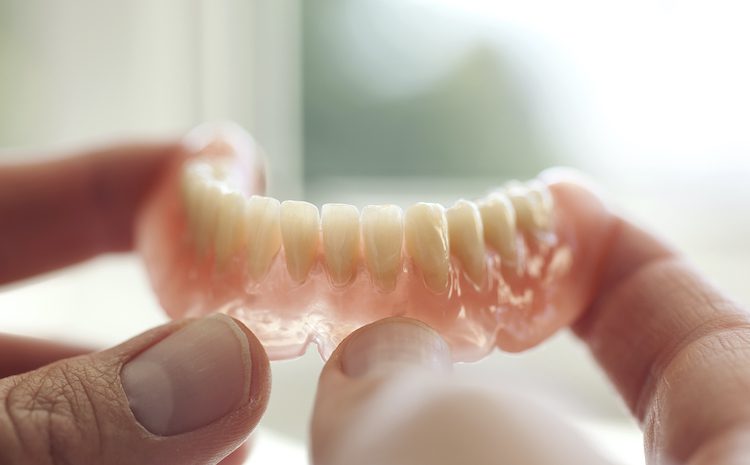
Your lower denture doesn’t have that. The floor of your mouth is not a dome. It’s a moving space with a tongue in the middle, cheeks on the sides, and a jaw that flexes and shifts every time you speak, swallow, or chew.
There’s no suction seal and no roof. The lower denture sits on a narrow bone ridge and relies on gravity, muscle control, and a little luck. That’s why the lower fits worse. It’s more of a physics problem than a fit problem.
The Second Reason: Bone Loss Happens Faster Down There
After you lose teeth, the lower jaw loses bone faster than the upper jaw. When you lose teeth, the bone that held them in place stops receiving the stimulation that keeps it dense. That bone starts to shrink. In the lower jaw, the ridge that supports a denture flattens and recedes more quickly. The jaw shape changes in a way that makes the denture progressively looser.
This is where Dr. Weinstock’s periodontics training matters. He spent three additional years in a perioprosthesis program at the University of Pennsylvania School of Dental Medicine, combining periodontics (gum and bone health) with prosthodontics (tooth replacement). He’s fitting an appliance onto a ridge and evaluating the health of the bone and gum tissue it depends on.
Most general dentists don’t have that training. They make the denture, they adjust it, and they reline it. But they don’t address the bone loss that’s causing the problem in the first place.
The Third Reason: The Tongue Has Other Plans
Your tongue is strong. It moves constantly. When a lower denture sits where your tongue needs to be, the tongue wins.
Every time you swallow, your tongue pushes against the denture. Every time you speak, it moves the denture slightly. Every time you eat, food gets between the denture and the gum, and the denture lifts.
Some patients learn to control this with muscle memory over time. Others never do. For patients with a strong gag reflex or a particularly active tongue, the lower denture becomes a daily frustration.
What a General Dentist Does vs. What a Prosthodontist Does
This part of the conversation matters most. Let’s compare the two approaches.
A general dentist typically makes the denture, adjusts it when it’s uncomfortable, and relines it when it gets loose. That’s a reasonable approach for a straightforward case, but the adjustments are reactive. They address the symptom, not the cause.
A prosthodontist looks at the whole system. Dr. Weinstock evaluates the bone, gum tissue, bite, jaw relationship, and how the denture will function within the whole mouth. He’s trained to recognize when a conventional denture is the right answer, when it isn’t, and how to plan alternatives.
That’s the difference. A general dentist makes a denture. A prosthodontist plans a solution.
The Options for a Floating Lower Denture
If your lower denture floats, you have several options. The right one depends on your bone health, your budget, your goals, and how much you’re willing to invest in the long-term outcome.
Option 1: A Better-Fitting Conventional Denture
Sometimes the problem is the denture itself, not the anatomy. A denture made years ago, or without a thorough evaluation, may not fit your jaw’s current shape. A new denture, made with careful impressions and a proper bite registration, can significantly improve fit.
This is the least invasive option. It’s also the least permanent, because the bone will continue to change over time.
Option 2: An Implant-Retained Overdenture
This is the option most patients know the least about. Dentists place two to four dental implants in the lower jaw, and the denture snaps onto them. The implants act as anchors, so the denture doesn’t float or shift.
For patients tired of adhesives, clicking, and food restrictions, this is often the solution they wish they’d known years earlier.
Dr. Weinstock’s combination of periodontics and prosthodontics training is directly relevant here. He’s trained in the surgical side (implant placement and bone health) and the restorative side (designing the denture that attaches to them). That means one doctor manages the whole process, from evaluating whether implants are appropriate to designing the final restoration. You won’t be handed off between a surgeon and a restorative dentist who never speak to each other.
Option 3: A Fixed Implant-Supported Prosthesis
For patients with more significant bone loss or more complex needs, a fixed implant-supported prosthesis may be the better answer. This treatment is more involved, but it provides the most stable result and doesn’t require removal for cleaning.
This is where Dr. Weinstock’s specialty training becomes essential. A fixed implant-supported prosthesis requires careful planning of the bite, the bone, and the restoration. It’s not a procedure for a dentist who places implants occasionally. It’s a procedure for a prosthodontist who specializes in it.
Option 4: A Phased Approach
Some patients aren’t ready for implants, either financially or emotionally. In that case, the right plan might be to improve the current denture’s fit, address any gum or bone issues, and plan for implants later. Dr. Weinstock’s approach is “one patient, one plan, one place,” which means the plan is designed around the patient’s actual situation, not a one-size-fits-all protocol.
Why the Lower Denture Problem Deserves a Specialist
You might be thinking, “Can’t my regular dentist just fix this?” And the honest answer is: sometimes yes, sometimes no.
If the problem is a simple fit issue, a general dentist can absolutely help. If the problem is bone loss, jaw changes, or a denture that doesn’t suit your anatomy, a specialist’s evaluation is worth it.
Dr. Weinstock is one of the few dentists in the Philadelphia region with advanced training in both periodontics and prosthodontics. He’s been a Clinical Professor at the University of Pennsylvania School of Dental Medicine since 1990, where he supervises dental students and teaches the next generation of dentists. He’s been named a Philadelphia Magazine “Top Dentist” for the last ten years.
That level of training and experience matters when it comes to a problem like this. A floating lower denture isn’t a minor inconvenience. It’s a daily frustration that affects how you eat, speak, and smile. It deserves more than another tube of adhesive.
What the Evaluation Looks Like
If you come to Dr. Weinstock’s office in Bala Cynwyd, the evaluation for a lower denture problem looks different from a standard dental visit.
He’ll examine the denture itself, the underlying bone and gum tissue, and how your jaw moves. He’ll take imaging to assess the bone volume and density. He’ll evaluate the bite and how the upper and lower dentures interact. He’ll also talk with you about your goals, your budget, and what you’re willing to invest in the outcome.
From there, he’ll give you a clear plan. It might be a new modern denture in his Philadelphia office. It might be an implant-retained overdenture. It might be a phased approach. It won’t be a generic recommendation that ignores your actual situation.
The office is at 15 Presidential Blvd, Suite 201, in Bala Cynwyd, PA. That’s a short drive from Philadelphia, the Main Line, and communities throughout the area. New patients can call (215) 857-8054 or request an appointment online.
If your lower denture has been floating for years and you’ve been told to just live with it, that’s not the only answer. Call and find out what a prosthodontist would do differently.